The sea can be the path home. Or the place that keeps you from it.
Brother of Zeus, lord of the seas and a god capable of unleashing devastating storms, Poseidon is one of the most powerful and imposing presences in the Odyssey.
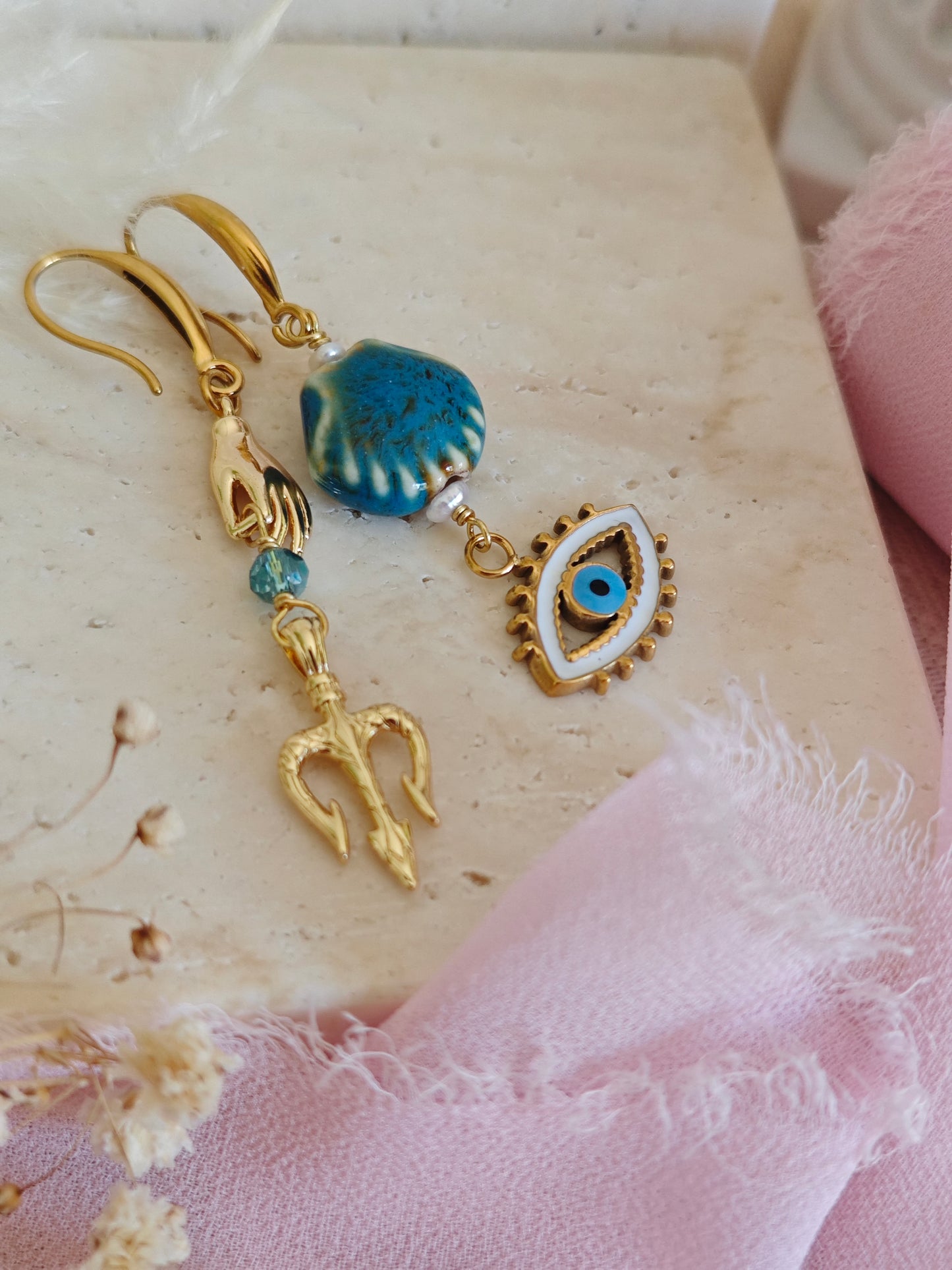
The Ποσειδῶν earrings, asymmetrical like the many stories woven into Odysseus' journey, portray the god through two of his most defining aspects: the power of the sea and the wrath born from an insult.
Handcrafted with hypoallergenic stainless steel ear hooks, they are available in both gold tone and silver tone.
One earring features a delicate hand holding an iridescent faceted blue bead and an intricately crafted trident, the unmistakable symbol of Poseidon and his dominion over the waters.
The other features a blue ceramic shell, accompanied by two small freshwater pearls and a white and blue enamel evil-eye bead.
But that eye conceals a darker meaning.
It represents Polyphemus, the Cyclops and son of Poseidon, blinded by Odysseus and his companions. Through him, the god's wrath enters the hero's journey: once Polyphemus discovers the identity of the man who blinded him, he calls upon his father to avenge him.
From that moment on, the sea Odysseus must cross to return to Ithaca also becomes the place of his punishment.
The two earrings therefore portray two inseparable sides of the same god: the sea that gives life and the sea that becomes an obstacle; the god who commands the waters and the wrath that turns them into a storm.
A piece for those who know the power of the sea — and understand that no journey home is ever entirely within our control.
The Roots of the Myth 🌿
Poseidon in the Odyssey
In the Odyssey, Poseidon is the principal divine antagonist of Odysseus' journey home. His hostility begins with the blinding of Polyphemus, his son, by the hero.
After escaping the Cyclops' cave, however, Odysseus makes a decision that will have far-reaching consequences: overcome by pride, he reveals his true identity to Polyphemus. The Cyclops then calls upon his father to take revenge, asking that Odysseus never return home — or that, if he does, he arrive only after suffering greatly and losing all his companions.
From that moment onward, the sea almost becomes a character in its own right: it is the distance separating Odysseus from Ithaca, but also the means through which Poseidon's wrath manifests itself.
The eye featured in these earrings is inspired by this connection. It is not merely a symbol of protection, but a small reference to Polyphemus, the lost eye that sets one of the most important threads of Odysseus' journey into motion.